Hassle free, 2-Year Warranty
Fast, Free Shipping on Orders $35+
Lifetime Technical Support
30-Day Money Back Guarantee
Plugable USB-C Extension Cable with Built-In Multimeter Tester, Fast Charging, 3.3 ft
$27.95 USD
SKU: USBC-METER3-1MFAmazon Rating : (143 Reviews)
Features
- At a Glance— Durable, high-performance 3.3’ (1M) USB-C extension cable (USBC-METER3-1MF) transfers data up to 10Gbps, supports 240W Extended Power Range, Alt Mode video up to 4K 60Hz, and features a digital power meter. It’s an incredibly versatile cable
- Ultra High-Speed Charging— Male to female USB-C extension cable delivers up to 240W, Video, and 10Gbps data. Connect it to your current charger and USB C charger cable,to charge even the most power-hungry laptops and devices from farther away. A whole 3.3’ (1m) farther away
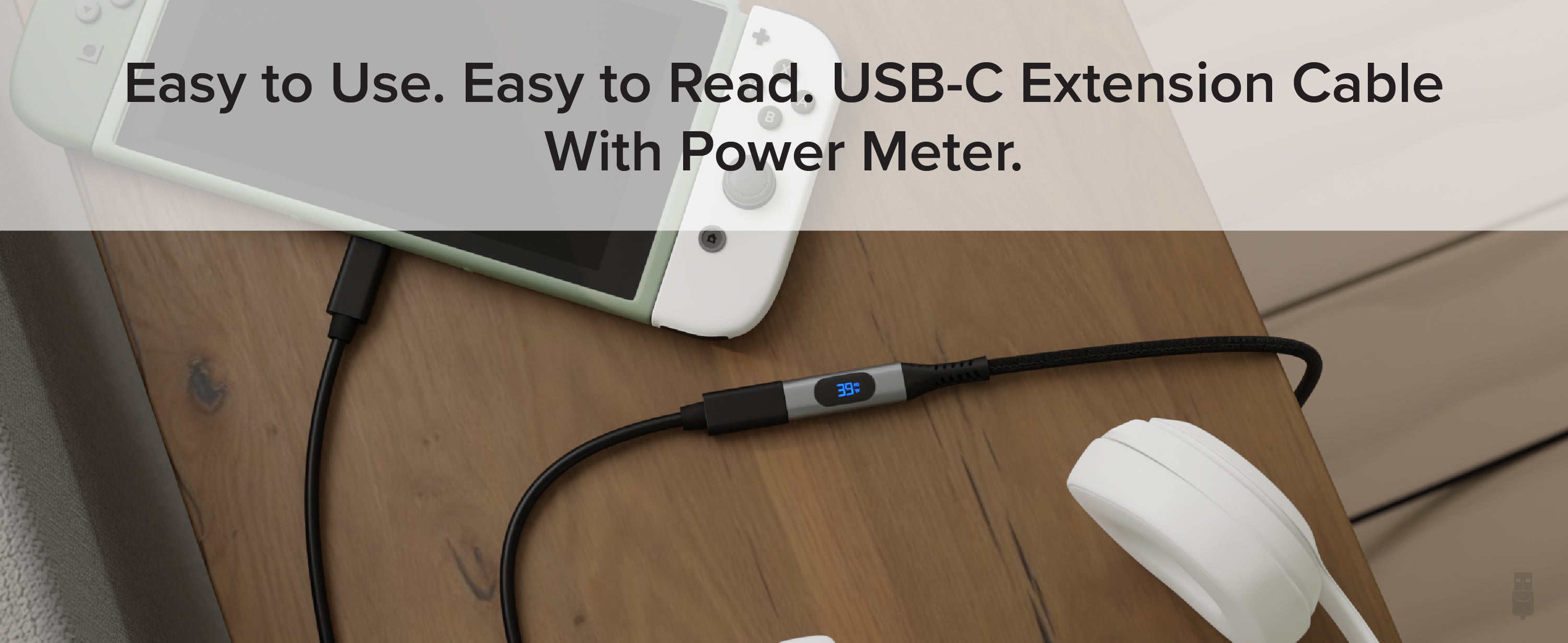
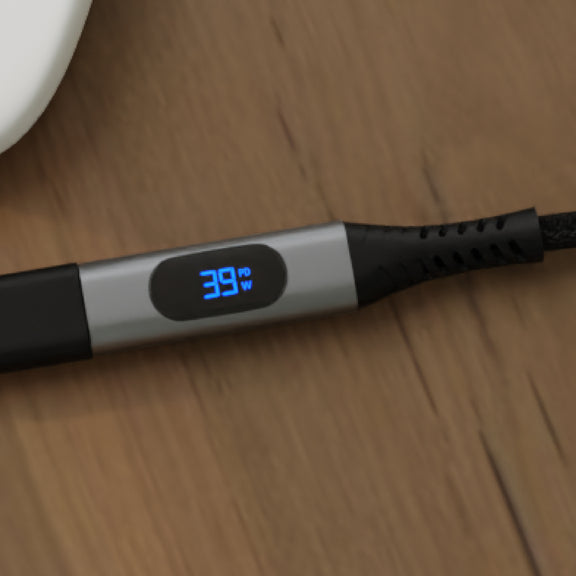
- Built-In Power Meter— Easy to use, digital read-out to monitor power usage or charging flow of your device, doesn’t sacrifice advanced USB-C features missing from lesser extenders. A braided black cord protects the USB C charging cable. This Type C to Type C cable is built to last
- Works With— Broad compatibility with USB-C devices and advanced features. It is worth noting that the power, data, and video capabilities are dependent on the capabilities of the USB-C cable and other devices connected to this extension cable
- 2-Year Coverage, Lifetime Support— Every Plugable product, including this 3ft USB C extension cable, is covered against defects for 2 years and comes with lifetime support. If you ever have questions, contact our North American-based team - even before purchase
For volume orders or business inquiries contact sales@plugable.com
Free 3-Day Continental U.S. Shipping on Orders Over $35!
All Buying Options
The Plugable USB 10Gbps USBC to USBC extension cable (male to female) with Built-In 240W Power Meter with Male and Female connection (USBC-METER3-1MF) has a lot going for it. For starters, it’ll extend your current USBC cable by 3.3’ (1m), and deliver up to 240W of charging power. That means you can combine it with your laptop’s USB-C charging cable to give you (and your laptop) a little extra room to move around.
When extending an equally capable USB Type C cable, like the Plugable USB4-240W-1M, get 240W Extended Power Range support, or support for video Alt mode at up to 4K 60Hz. It also supports impressive 10Gbps data transfer speeds. It also braided cord and the aluminum housing to keep it durable.
Of course, the most unique feature of the Plugable USB-C to USB-C cable is the built-in USB power meter. Now your USB C cord can monitor your power draw and consumption. Check to see if all of your laptop’s USB-C ports deliver the same charge. And you’ll finally find out if that “Super Best Fast Speed Charger” you ordered (I mean it was so cheap how could you resist) actually delivers the charge it claims on the package.
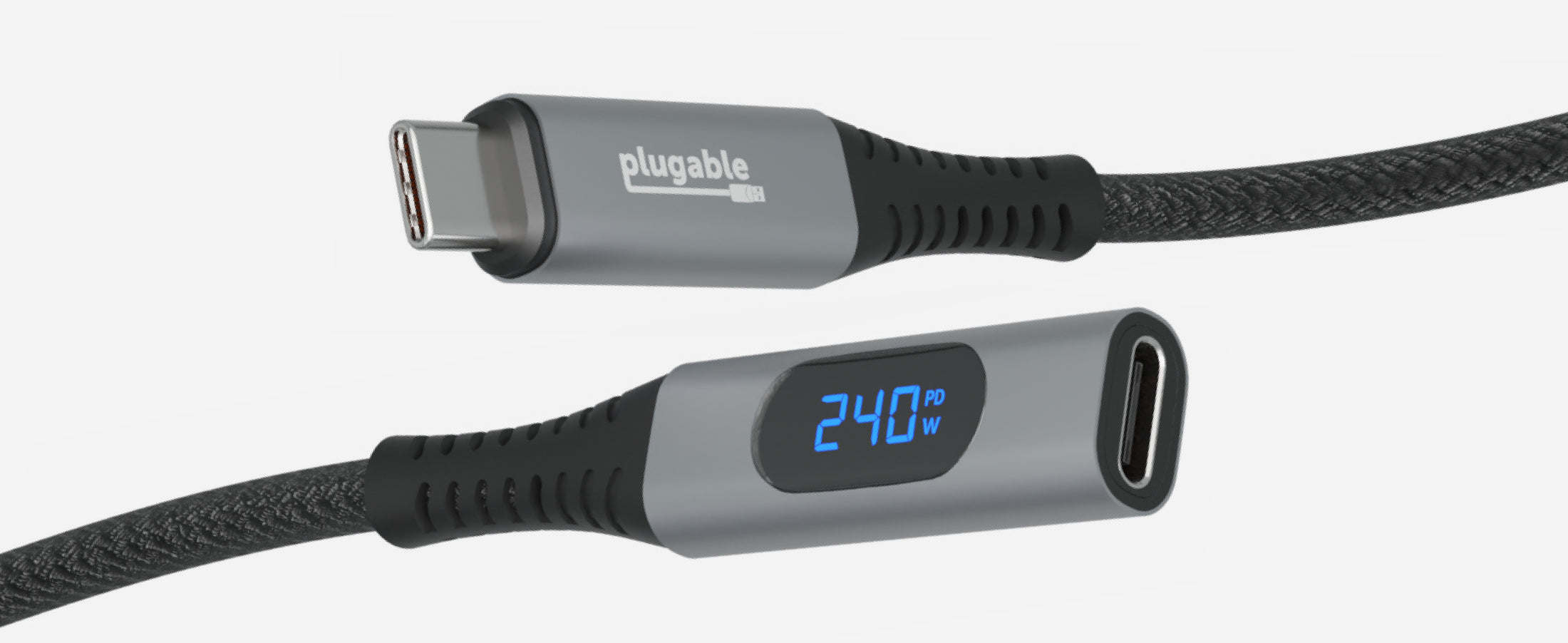
Built-In Power Meter
Measure your power flow and consumption with real-time monitoring on the digital power meter.
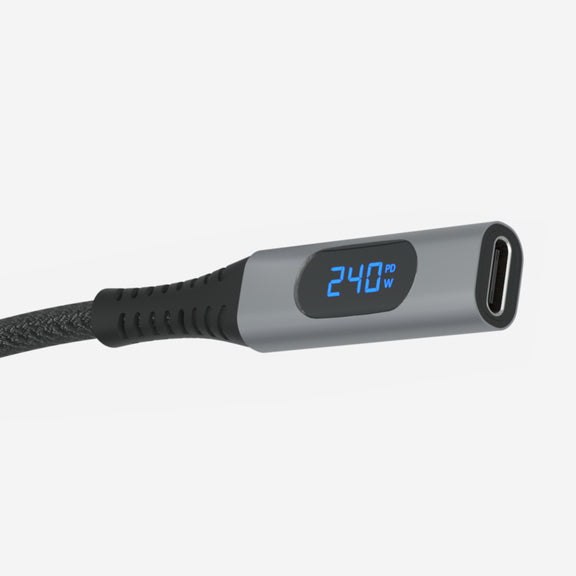
240W Extended Power Range
The first USB-C extension cable with a power meter capable of 240W power delivery.
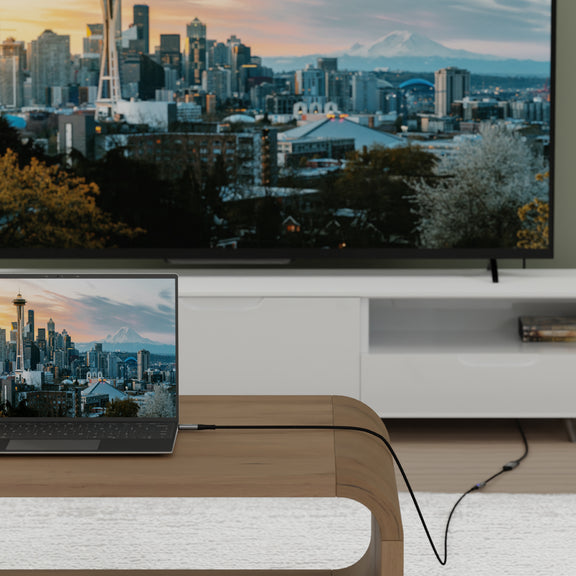
4K 60Hz Video
Supports video over USB-C DisplayPort Alternate Mode at up to 4K 60Hz.
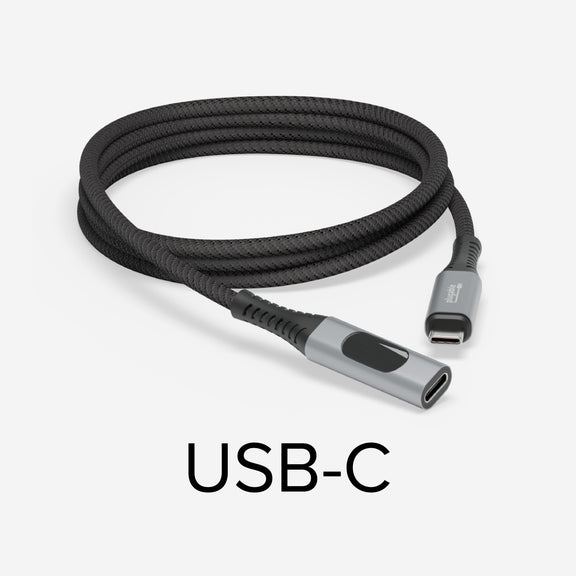
Compatibility
Compatible with most USB-C devices. Actual performance depends on connected devices.
In The Box
| Item and Quantity | Item Notes |
|---|---|
| 1x USB Type-C 1m Extension Cable |
Included Cables
| Port Type (Side 1) | Cable Specification | Port Type (Side 2) | Cable Length | External Power for Cable |
|---|---|---|---|---|
| Male USB-C | USB 3.2 Gen 2 (10Gbps) | USB-C | 1.0m/3.28ft | No |
Video
| Port | Placement | Specification | Max Resolution and Refresh Rate | HDCP | Chipset |
|---|---|---|---|---|---|
| 1x USB-C (Bi-Directional) |
Cable End | Host Dependent | 3840x2160 @ 60Hz 3840x2160 @ 60Hz3840x1600 @ 60Hz 3440x1440 @ 60Hz 2560x1440 @ 60Hz 2560x1080 @ 60Hz 1920x1080 @ 60Hz 1600x900 @ 60Hz 1280x1024 @ 60Hz 1280x800 @ 60Hz 1280x720 @ 60Hz 1152x864 @ 60Hz 1024x768 @ 60Hz 800x600 @ 60Hz 640x480 @ 60Hz |
Supported |
Video Output Modes
| Host Stream Specification | Host Port Type | Number of Displays Used | Max Resolution at Display Count |
|---|---|---|---|
| USB-C | 1 | 3840x2160 @ 60Hz |
Connection To Host
| Port | Placement | Version and Link Rate | Features |
|---|---|---|---|
| 1x USB-C | Cable End | USB 3.2 Gen 2 (10Gbps) |
Physical Stats
| Item | Size (H x W x D) or Length | Weight | SKU or Part Number |
|---|---|---|---|
| USB-C Extension Cable | 1 meters 3.3 feet |
48 grams 1.7 ounces |
USBC-METER3-1MF |
When paired with a capable USB-C cable this USB-C extension cable is compatible with virtually all USB-C chargers, devices, and hosts, including support for USB 10Gbps, DisplayPort Alternate Mode video (up to 4K 60Hz), and up to 240W USB-C Power Delivery R3.1 EPR (Extended Power Range) charging. Not compatible with Intel Thunderbolt 3, 4, or USB4 devices.
How it works:
This USB-C extension cable with meter is a transparent interposer–it should not interfere with USB data, USB-C Alternate Mode video, or USB-C charging. The cable can be used in-line with USB-C docking stations, chargers, and other USB-C accessories. The cable is able to achieve this without interfering with normal USB-C operation as it only taps into the power (VBUS) and ground connections to measure values and leaves the data lines untouched.
The Plugable USB-C Extension Cable is bi-directional, however, typical usage will have the male side (without power meter display) connected to a charger for example, and the female end (with power meter display) will be connected to another USB-C to USB-C cable going to the device being charged.
Another common use case would be using this cable to provide easier access to a hard to reach USB-C port on the back of a desktop computer or docking station, extending the USB-C connection to a more convenient location and with the meter display easily viewable.
Ultimately which side is used for input or output does not matter. If current is flowing, the meter's display should turn on and show the approximate charge rate in watts.
Important notes:
- This USB-C extension cable with meter is not meant to replace professional USB-C test equipment, it is designed for quick/easy measurement of wattage for users of any skill level.
- Not compatible with Intel Thunderbolt 3, 4, or USB4 devices.
- Under normal circumstances the meter will not power on without a device connected (host, charger, accessory, etc) at both ends. If the meter turns on when only connected at one end, the attached device is "VBUS hot" which is against USB-C specifications.
Questions? We're here to help! Please reach out to us at support@plugable.com
Filter Help Articles and Frequent Questions by Category
Choose one or more filters within each category to narrow down the articles. Each selection will result in only displaying articles that include all of your choices.
Articles
Well how about that, it looks like we don't have any articles matching your filters! Try removing one of your choices or clear the filters to show all articles.
You can always contact support if you need help too!
Why can't I drive two external extended displays with my Google Pixel phone?
Google Pixel phones support USB-C DisplayPort Alternate Mode for wired video output, but due to Android OS limitations, they cannot produce two extended external displays using MST, DisplayLink, or Thunderbolt docking technologies. This is a platform constraint, not a hardware or dock issue.
Understanding the Limitation
Google Pixel phones are limited by the Android operating system’s handling of external displays. While many Pixel models (such as the Pixel 7 and Pixel 8 series) support USB-C DisplayPort Alternate Mode, they can only output to a single external display at a time. Android is designed primarily for screen mirroring, and extended display support is extremely limited across Android phones.
Key Point:
Android OS currently restricts Pixel phones to one external display, regardless of the dock or adapter used.
Dock Behavior with Pixel Phones
MST Docks (e.g., Plugable UD-MSTH2)
MST (Multi-Stream Transport) requires the host device to support splitting one DisplayPort signal into multiple independent video streams. While common on Windows and many Chromebooks, Pixel phones do not support MST for extended displays.
When using an MST dock, a Pixel phone will:
- Output to one external display only, or
- Mirror the same content to two connected monitors
- Dual extended desktops are not supported
DisplayLink Docks
DisplayLink technology works on Android through a companion app (e.g., DisplayLink Presenter). However:
- Android only supports a single external display via DisplayLink
- DisplayLink docks cannot be used to achieve multiple extended monitors from a Pixel device
- DisplayLink is not recommended for dual display use on Android
Thunderbolt Docks
Google Pixel phones are not Thunderbolt-certified hosts. When connected to a Thunderbolt dock:
- They revert to basic USB-C DisplayPort Alternate Mode
- Only a single mirrored display is possible
Visual Summary
| Dock Type | Extended Displays | Mirroring | Notes |
|---|---|---|---|
| MST Dock | ❌ | ✅ | No MST support on Android |
| DisplayLink Dock | ❌ | ✅ | Requires DisplayLink app |
| Thunderbolt Dock | ❌ | ✅ | Functions as USB-C only |
Recommended Alternatives
If your goal is to use two independent external displays, consider the following instead:
- Windows laptops with DisplayPort MST support
- Chromebooks that support MST
Frequently Asked Questions
Q: Can I extend my Pixel’s screen to two monitors using any method?
A: No. As of now, Android does not support multiple extended displays. Only mirroring to one display is possible.
Q: Does DisplayLink allow multiple displays on Android?
A: No. Even with DisplayLink’s Android app, you are limited to one external display.
Q: Why do Windows and ChromeOS devices work with MST but not Android?
A: Android lacks support for DisplayPort MST and advanced GPU capabilities required for multiple display outputs. This is a software/platform-level limitation.
Conclusion
While Google Pixel phones are capable of driving a single external display, dual extended monitors are not possible due to Android OS restrictions. This applies across all dock types, including MST, DisplayLink, and Thunderbolt. For users requiring robust multi-display setups, we recommend using a Windows or Chromebook device that supports MST alongside a compatible docking station like the Plugable UD-MSTH2.
If you have any questions or need help selecting a compatible dock, reach out to our support team at support@plugable.com.
What is USB-C Power Delivery R3.1 Extended Power Range (EPR)?
The new USB Power Delivery specifications allow for the delivery of up to 240W via a USB Type-C cable (an increase from the previous 100W max). The previous Power Delivery range has been relabeled as Standard Power Range (SPR), and the new specifications (between 100W and 240W), have been labeled as Extended Power Range (EPR).
For a more in-depth look feel free to check out our blog post on this topic here: https://plugable.com/blogs/news/what-is-240w-usb-extended-power-range-epr
USB-C vs. Thunderbolt: Understanding the Differences
While USB-C and Thunderbolt share the same physical rounded rectangle connector they operate in fundamentally different ways.
The Main Differences Aren't Physical
USB 3 at 5Gbps and 10Gbps with Type-C - often simplified to USB-C - is both the hardware connector standard, and the included data types: USB 5Gbps or 10Gbps data rates, as well as optionally DisplayPort Alternate Mode video and USB Power Delivery for powering and charging both host computers, and downstream devices.
Thunderbolt, specifically Thunderbolt 3 and newer and USB4 use the same physical USB Type-C port, and support a backwards compatibility with USB-C devices, however the signaling and data structure is completely different. Both Thunderbolt and USB4 operate at between four to sixteen times the speed of USB 3. While USB offers optional display and charging, these are mandatory for Thunderbolt hosts. The way display data is transmitted is also different.
DisplayPort Alternate Mode for USB 3 occupies two or four of the physical data lanes in the USB Type-C connector and cable. Tunneled DisplayPort video in Thunderbolt (and USB4) packetizes the DisplayPort video data and transmits it within Thunderbolt/USB4 data packets. Tunneled DisplayPort allows for more native DisplayPort streams enabling multiple external displays at higher resolutions and refresh rates.
Power Delivery is the USB Type-C (as in the port) charging and power standard - this allows a power source and device to negotiate a voltage and maximum amperage both devices can support. For example a phone might negotiate a 9V 3A charge rate which is close to optimal for a phone size battery, while a notebook computer is more likely to negotiate 20V 5A both for improved battery charging and to power the system under moderate to heavy workloads.
Why USB-C and Thunderbolt Capabilities Differ
USB Type-C is a connector standard where features such as video output (DisplayPort Alt Mode) and USB Power Delivery (PD) are optional and depend on the host device manufacturer. In contrast, Thunderbolt sets mandatory performance and hardware requirements across data, video, and power protocols.
- USB 3.0 / 3.1 Gen 1: Up to 5Gbps data transfer speed.
- USB 3.2 Gen 2: Up to 10Gbps data transfer speed.
- USB 3.2 Gen 2x2: Up to 20Gbps data transfer speed. This is very rarely implemented and most computers do not support it.
- Thunderbolt 3: Up to 40Gbps data transfer speed, supports dual DisplayPort 1.2 enabling two 4K or a single 5K displays, USB, DisplayPort, PCIe over a single cable, and up to 100W Power Delivery.
- USB4: Up to 40Gbps data transfer speed, supports DisplayPort 1.4 either one or two external displays, PCIe, and optional Thunderbolt 3 compatibility, USB 3.2 Gen 2 10Gbps, and Power Delivery.
- Thunderbolt 4: Up to 40Gbps data transfer speed, supports dual 4K or single 8K displays, USB4 compatibility, USB 3.2 Gen 2 10Gbps, and Power Delivery.
- Thunderbolt 5: Up to 80Gbps bi-directional bandwidth (DisplayPort up to 120Gbps using Bandwidth Boost), supports dual 6K or single high-refresh-rate 8K displays, PCIe, and backward compatibility with Thunderbolt 4 and USB4, USB 3.2 Gen 2 10Gbps.
Effectively each tier from this list supports all of the features of the tier above as well as some new features. Thunderbolt 4 is Intel's implementation of USB4 with all optional features enabled.
How to Identify Ports and Ensure Compatibility
- Port Identification: Thunderbolt ports are usually marked with a lightning bolt symbol with a downward pointing triangle at the bottom point, this should be next to the port, while USB-C ports may be unmarked or feature symbols indicating power delivery (a simple lightning bolt is common) or DisplayPort capabilities ("DP" logo is often used). Always refer to device technical specifications for confirmation.
- Connecting Thunderbolt Devices to USB-C Ports: Thunderbolt 3, 4, or 5 devices connected to standard USB-C ports typically operate at reduced capabilities, such as lower speeds or fewer display outputs.
- Connecting USB-C Devices to Thunderbolt Ports: USB-C devices connected to Thunderbolt ports function normally, but cannot take advantage of full Thunderbolt features.
Applicable To
- Plugable docking stations, hubs, and video adapters
- USB-C standards (USB 3.0, 3.1 Gen 1, 3.2 Gen 2, 3.2 Gen 2x2, USB4)
- Thunderbolt standards (Thunderbolt 3, Thunderbolt 4, Thunderbolt 5)
If you have any questions please feel free to contact us at support@plugable.com and we'll be happy to help!
Can I connect this product to a computer's Thunderbolt/Thunderbolt 2 port?
Many users assume that USB-C devices can work with older Thunderbolt 2 Macs if they use a Thunderbolt 3 to Thunderbolt 2 adapter, such as the one made by Apple. However, this is not the case. These adapters are specifically designed to support Thunderbolt devices only - not standard USB-C peripherals.
While Thunderbolt 3 and USB-C share the same connector type, they use different underlying data protocols. Non-Thunderbolt USB-C devices, rely on USB standards for data and power. The Thunderbolt 3 to Thunderbolt 2 adapter does not carry USB signals; it only passes Thunderbolt data. Because of this, plugging a USB-C device into a Thunderbolt 2 Mac using this adapter will not work - the computer will not detect or communicate with the device.
If you need to connect peripherals to a Thunderbolt 2 system, we recommend using a USB-A dock or hub (if available on your system). This ensures compatibility without relying on unsupported adapter chains.
In short, even though the connectors may fit, USB-C devices are not compatible with Thunderbolt 2 Macs via Thunderbolt adapters - only Thunderbolt devices will work in that setup.
- Choosing a selection results in a full page refresh.
Presale Signup
Please note: Not all products are available globally