- Connect one end of the USB-C cable to the host device.
- Connect the other end of the USB-C cable to the other desired device.
Questions? We're here to help! Please reach out to us at support@plugable.com
Hassle free, 2-Year Warranty
Fast, Free Shipping on Orders $35+
Lifetime Technical Support
30-Day Money Back Guarantee
Features
For volume orders or business inquiries contact sales@plugable.com
Free 3-Day Continental U.S. Shipping on Orders Over $35!
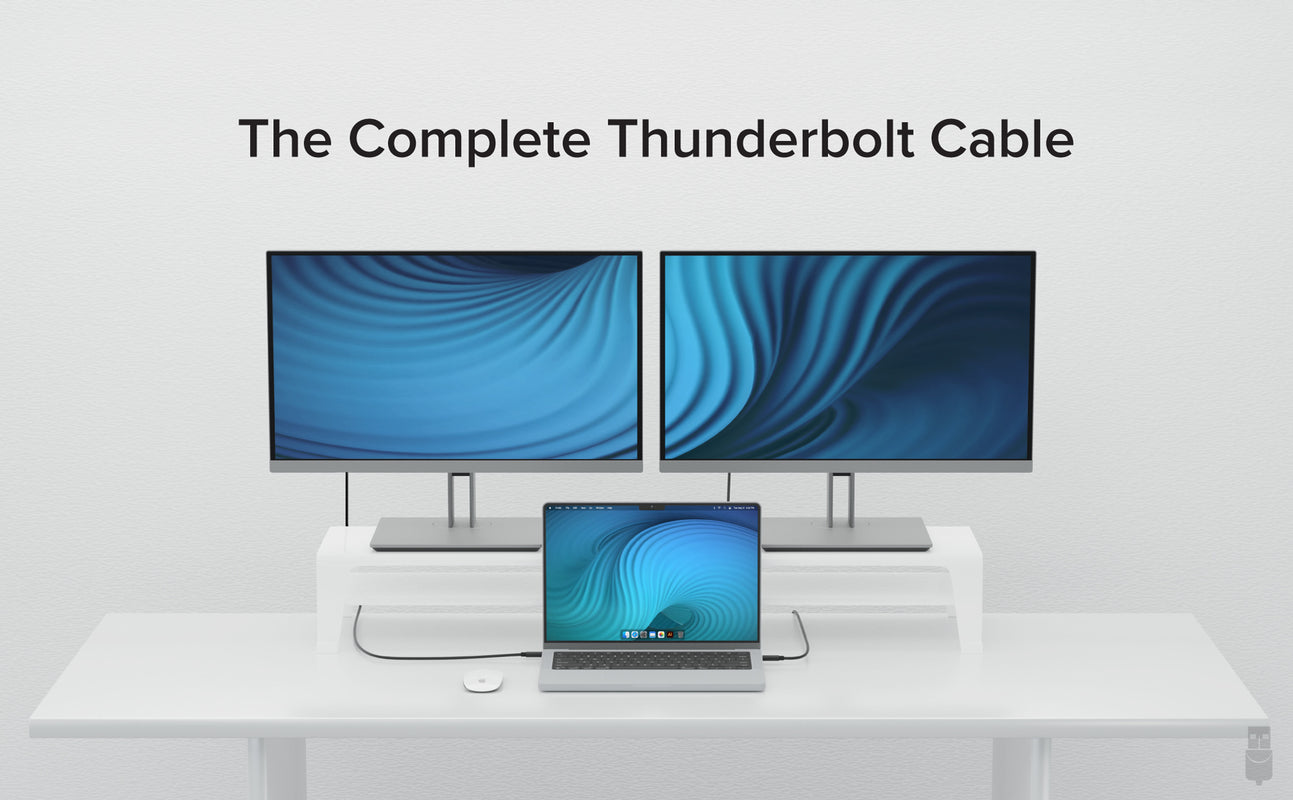
The Complete Thunderbolt Cable
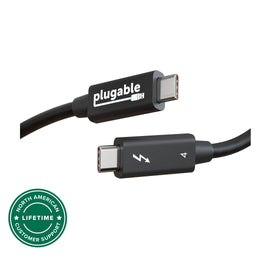
The Plugable Thunderbolt 4 EPR cable is built to deliver a true Thunderbolt experience.
Incredibly fast 40Gbps data transfer speeds and support for two 4K screens or one 8K screen is just the start. With Extended Power Range (EPR), this cable is built with the future in mind and can deliver up to 240W. And because it’s Thunderbolt Certified, it can be used as a Thunderbolt 3 cable in your Thunderbolt 3 dock—and that’s true for USB-C and USB4, too.
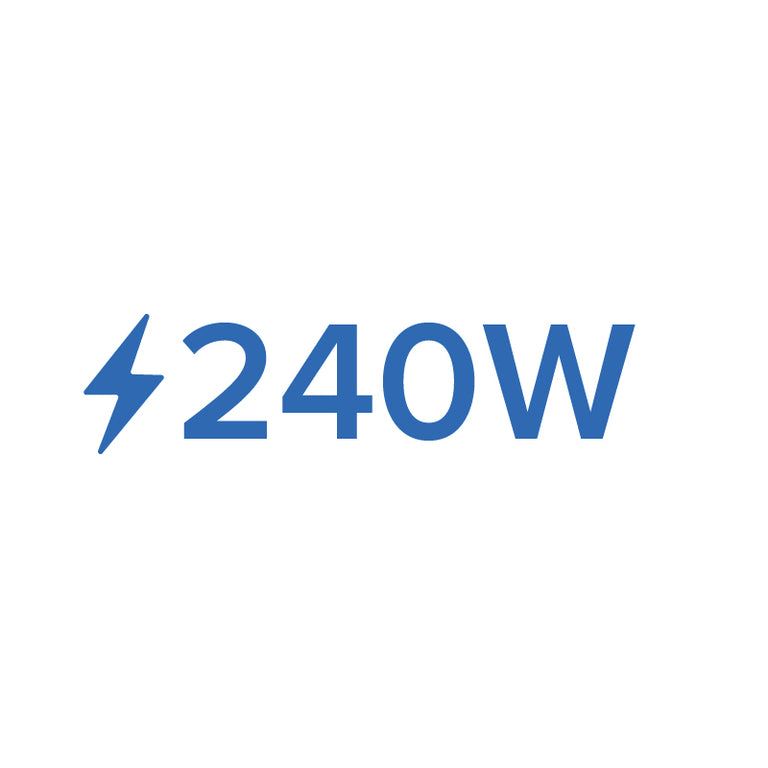
240W Extended Power Range
When we say this cord offers Extended Power Range (EPR), we mean it can carry up to 240W, unlike previous generations of cables that max out at 100W.
For many, this will be considered a fast charging option. And that’s no surprise, because with 240W, you can power just about any laptop on the market, and those to come.
As more devices begin to integrate EPR functionality, you’ll find this cable has you future-proofed.
Thunderbolt Certified
Often overlooked, the cables connecting our computers to their peripherals have an important part to play. That’s why our Thunderbolt 4 EPR cables are Thunderbolt Certified, it’s the only official way to ensure you’re getting complete compatibility and reliability. That means this cable with speeds up to 40Gbps, 240W 48V/5A EPR, is backward compatible with previous generations of Thunderbolt and USB.
Future-Proof with Thunderbolt 4
Thunderbolt 4, USB4, or USBC to USBC cable, what is it? All of the above. And a little more.
This cable is Thunderbolt 4 certified, and that comes with some incredible benefits. Thunderbolt 4, Thunderbolt 3, USB4, or USB-C, it doesn’t matter, the Plugable Thunderbolt 4 EPR cable will work. Even at a full meter (3.3ft), you won't see a decrease in performance.
It should be noted that actual performance is determined by the capabilities of the host and peripheral(s).
| Item and Quantity | Item Notes |
|---|---|
| 1x Thunderbolt 4 240W 1m Cable |
| Port Type (Side 1) | Cable Specification | Port Type (Side 2) | Cable Length | External Power for Cable |
|---|---|---|---|---|
| Male Thunderbolt™ 4 or Thunderbolt™ 3 or USB-C | Thunderbolt™ 4 (40Gbps) | Thunderbolt™ 4 or Thunderbolt™ 3 or USB-C | 1.0m/3.28ft | No |
| Port | Placement | Specification | Max Resolution and Refresh Rate | HDCP | Chipset |
|---|---|---|---|---|---|
| 1x USB-C (Bi-Directional) |
Cable End | Host Dependent | 5120x2880 @ 60Hz 7680x4320 @ 30Hz4096x2160 @ 60Hz 3840x2160 @ 60Hz 3840x1600 @ 60Hz 3440x1440 @ 60Hz 2560x1440 @ 60Hz 1920x1080 @ 60Hz 1600x900 @ 60Hz 1280x1024 @ 60Hz 1280x800 @ 60Hz 1280x720 @ 60Hz 1152x864 @ 60Hz 1024x768 @ 60Hz 800x600 @ 60Hz 640x480 @ 60Hz |
Supported |
| Host Stream Specification | Host Port Type | Number of Displays Used | Max Resolution at Display Count |
|---|---|---|---|
| Thunderbolt™ 4 or Thunderbolt™ 3 or USB-C | 2 | 4096x2160 @ 60Hz |
| Port | Placement | Version and Link Rate | Features |
|---|---|---|---|
| 1x Thunderbolt™ 4 or Thunderbolt™ 3 or USB-C | Cable End | Thunderbolt™ 4 (40Gbps) |
| Item | Size (H x W x D) or Length | Weight | SKU or Part Number |
|---|---|---|---|
| Thunderbolt 4 Cable | 1 meters 3.3 feet |
55 grams 1.9 ounces |
TBT4-240W-1M |
Compatibility
Compatible with Thunderbolt 4, USB4, Thunderbolt 3, and USB-C hosts (Windows, macOS, Linux, ChromeOS) as well as Thunderbolt 4, USB4, Thunderbolt 3, and USB-C docks, hubs, storage devices, monitors, tablets, phones and eGPUs.
Get Started
Questions? We're here to help! Please reach out to us at support@plugable.com
Choose one or more filters within each category to narrow down the articles. Each selection will result in only displaying articles that include all of your choices.
Well how about that, it looks like we don't have any articles matching your filters! Try removing one of your choices or clear the filters to show all articles.
You can always contact support if you need help too!
Google Pixel phones support USB-C DisplayPort Alternate Mode for wired video output, but due to Android OS limitations, they cannot produce two extended external displays using MST, DisplayLink, or Thunderbolt docking technologies. This is a platform constraint, not a hardware or dock issue.
Google Pixel phones are limited by the Android operating system’s handling of external displays. While many Pixel models (such as the Pixel 7 and Pixel 8 series) support USB-C DisplayPort Alternate Mode, they can only output to a single external display at a time. Android is designed primarily for screen mirroring, and extended display support is extremely limited across Android phones.
Key Point:
Android OS currently restricts Pixel phones to one external display, regardless of the dock or adapter used.
MST (Multi-Stream Transport) requires the host device to support splitting one DisplayPort signal into multiple independent video streams. While common on Windows and many Chromebooks, Pixel phones do not support MST for extended displays.
When using an MST dock, a Pixel phone will:
DisplayLink technology works on Android through a companion app (e.g., DisplayLink Presenter). However:
Google Pixel phones are not Thunderbolt-certified hosts. When connected to a Thunderbolt dock:
| Dock Type | Extended Displays | Mirroring | Notes |
|---|---|---|---|
| MST Dock | ❌ | ✅ | No MST support on Android |
| DisplayLink Dock | ❌ | ✅ | Requires DisplayLink app |
| Thunderbolt Dock | ❌ | ✅ | Functions as USB-C only |
If your goal is to use two independent external displays, consider the following instead:
Q: Can I extend my Pixel’s screen to two monitors using any method?
A: No. As of now, Android does not support multiple extended displays. Only mirroring to one display is possible.
Q: Does DisplayLink allow multiple displays on Android?
A: No. Even with DisplayLink’s Android app, you are limited to one external display.
Q: Why do Windows and ChromeOS devices work with MST but not Android?
A: Android lacks support for DisplayPort MST and advanced GPU capabilities required for multiple display outputs. This is a software/platform-level limitation.
While Google Pixel phones are capable of driving a single external display, dual extended monitors are not possible due to Android OS restrictions. This applies across all dock types, including MST, DisplayLink, and Thunderbolt. For users requiring robust multi-display setups, we recommend using a Windows or Chromebook device that supports MST alongside a compatible docking station like the Plugable UD-MSTH2.
If you have any questions or need help selecting a compatible dock, reach out to our support team at support@plugable.com.
Yes, this Thunderbolt 4 cable is compatible with any USB-C port for data transfer, charging, or video (capabilities will depend on peripheral used).
Thunderbolt 4 Cables
Yes, Thunderbolt 4 cables can support up to 240W of power allowing you to keep your devices charged, but some cables may not offer the full 240W capability and instead offer a maximum of 100W of Power Delivery.
Yes, Thunderbolt 4 cables are backward compatible with Thunderbolt 3 and USB-C devices.
Thunderbolt 4 Cables
While the TBT4-240W-1M and USB4-240W-1M are essentially identical in terms of specifications, the TBT4-240W-1M has passed Intel's notoriously rigorous Thunderbolt™ Certification, which makes it officially Thunderbolt™ Certified.
The USB4-240W-1M is USB-IF Certified, which is another set of high standards to ensure functionality and interoperability. While it is not officially Thunderbolt™ Certified, it is still fully compatible with Thunderbolt™ devices. The TBT4-240W-1M is also USB-IF Certified.
The new USB Power Delivery specifications allow for the delivery of up to 240W via a USB Type-C cable (an increase from the previous 100W max). The previous Power Delivery range has been relabeled as Standard Power Range (SPR), and the new specifications (between 100W and 240W), have been labeled as Extended Power Range (EPR).
For a more in-depth look feel free to check out our blog post on this topic here: https://plugable.com/blogs/news/what-is-240w-usb-extended-power-range-epr
Yes! Our 240W cables can transfer up to 240 watts of power, which means that it can also transfer lower wattages such as 45W, 60W, 85W, 100W, 140W, and anything in between.
All 240W supporting USB-C cables
While USB-C and Thunderbolt share the same physical rounded rectangle connector they operate in fundamentally different ways.
USB 3 at 5Gbps and 10Gbps with Type-C - often simplified to USB-C - is both the hardware connector standard, and the included data types: USB 5Gbps or 10Gbps data rates, as well as optionally DisplayPort Alternate Mode video and USB Power Delivery for powering and charging both host computers, and downstream devices.
Thunderbolt, specifically Thunderbolt 3 and newer and USB4 use the same physical USB Type-C port, and support a backwards compatibility with USB-C devices, however the signaling and data structure is completely different. Both Thunderbolt and USB4 operate at between four to sixteen times the speed of USB 3. While USB offers optional display and charging, these are mandatory for Thunderbolt hosts. The way display data is transmitted is also different.
DisplayPort Alternate Mode for USB 3 occupies two or four of the physical data lanes in the USB Type-C connector and cable. Tunneled DisplayPort video in Thunderbolt (and USB4) packetizes the DisplayPort video data and transmits it within Thunderbolt/USB4 data packets. Tunneled DisplayPort allows for more native DisplayPort streams enabling multiple external displays at higher resolutions and refresh rates.
Power Delivery is the USB Type-C (as in the port) charging and power standard - this allows a power source and device to negotiate a voltage and maximum amperage both devices can support. For example a phone might negotiate a 9V 3A charge rate which is close to optimal for a phone size battery, while a notebook computer is more likely to negotiate 20V 5A both for improved battery charging and to power the system under moderate to heavy workloads.
USB Type-C is a connector standard where features such as video output (DisplayPort Alt Mode) and USB Power Delivery (PD) are optional and depend on the host device manufacturer. In contrast, Thunderbolt sets mandatory performance and hardware requirements across data, video, and power protocols.
Effectively each tier from this list supports all of the features of the tier above as well as some new features. Thunderbolt 4 is Intel's implementation of USB4 with all optional features enabled.
If you have any questions please feel free to contact us at support@plugable.com and we'll be happy to help!
All Thunderbolt docking stations include the appropriate Thunderbolt cable in order to connect the docking station to the host computer. As of this writing, all Plugable Thunderbolt host cables that are included with Plugable Thunderbolt docking stations are 1.0 meter (approximately 3.3) feet in overall length.
For reference, the specifications of all Plugable Thunderbolt cables are printed on a small white cable flag attached to the cable itself.
If the original 1.0 meter long Thunderbolt host cable is not sufficient for a specific use case, longer cables of up to 2.0 meters (approximately 6.6 feet) in overall length can be purchased separately from Plugable. An example of such a cable is the Plugable TBT4-40G2M cable
Plugable does NOT support using Thunderbolt host connection cables that are over 2.0 meters in overall length with any Plugable brand product.
Plugable does NOT support the use of any type of Thunderbolt extension cable or any type of signal repeater in conjunction with our products.
Please note, Plugable can only guarantee the performance and compatibility of Plugable brand cables.
Please note: Not all products are available globally